
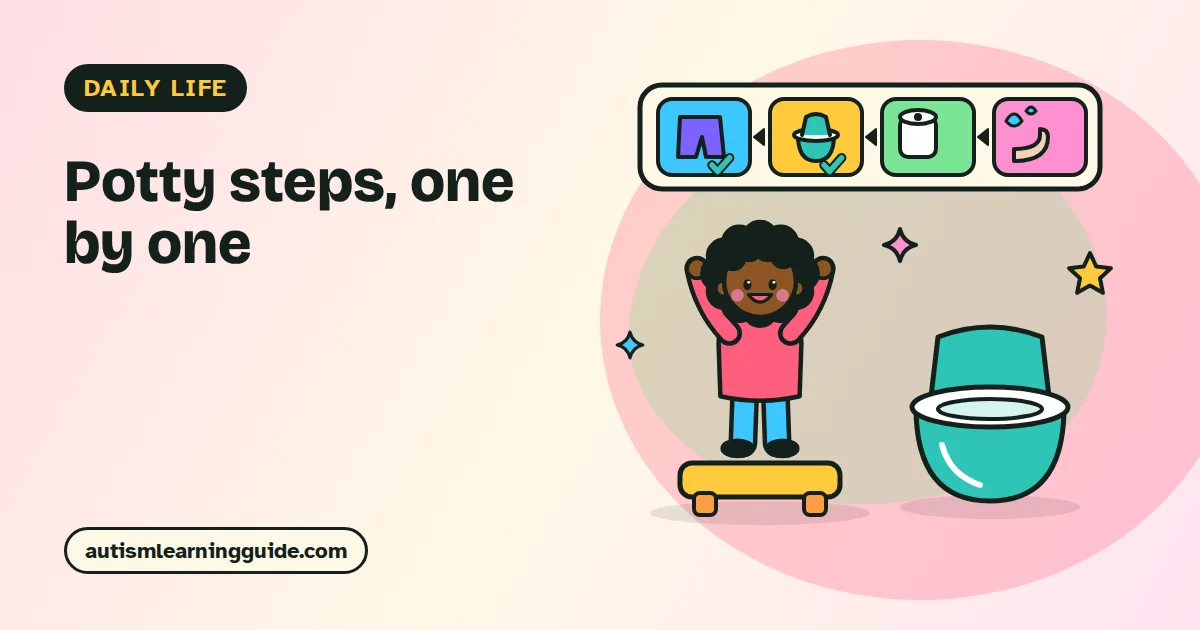
Toilet training an autistic child often takes longer than with other children, and that is common and OK. Sensory sensitivities, communication differences, or constipation can make it harder. A calm, step-by-step plan using a routine, visual supports, and lots of praise, along with a check by your child’s doctor, gives your child the best chance of success.
Key points
- Resistance to toilet training is much more common in autistic children than in other children.
- Readiness signs are the same for all children, but autistic children often finish training later.
- Constipation is common and can block progress. Ask your doctor to check for it first.
- Break toileting into small steps, show them with pictures, and use a regular sitting schedule.
- Keep it positive. Motivation matters more than speed.
On this page
Why toilet training an autistic child can take longer
A large CDC-funded study of children aged 4 and older found that toileting resistance was reported in 49% of autistic children, compared with 24% of children with other developmental delays and 8% of children in the general population [1]. In autistic children, resistance was linked with constipation, diarrhea, delays in expressive language, and lower social motivation [1].
The American Academy of Pediatrics (AAP) notes that children with special needs often start later and frequently finish toilet training at age 5 or even later [2]. International continence experts also report that wetting, soiling, and constipation are more common in children with neurodevelopmental conditions, including autism, and that treatment works best when adapted to the child [3].
Common reasons toileting is harder include:
- Sensory differences: the noise of the flush or hand dryer, a cold seat, bright lights, or the smell of the bathroom.
- Body awareness: some children do not easily notice the feeling of a full bladder or bowel.
- Communication: your child may not have a way to tell you they need to go.
- Love of routine: a change from diapers to the toilet is a big change in a familiar routine.
- Constipation or painful stools, which can make a child afraid to go.
Check for constipation first
The AAP lists constipation among the common health issues in young autistic children [4], and constipation was linked with toileting resistance in the CDC study [1]. If pooping hurts, your child may hold it in, which makes the problem worse.
Before you start, ask your pediatrician to check for constipation or loose stools, as the AAP recommends for children with special needs [2]. Fluids and fiber can help, but your doctor will advise whether any treatment is needed. UK NICE guidance also points clinicians to its constipation guideline when supporting autistic children [5].
Signs your child may be ready
The AAP says that readiness signs are the same for children with special needs as for all children [2]. Look for signs such as:
- staying dry for an hour or two at a time,
- showing awareness of being wet or dirty, even if only by fussing or pulling at the diaper,
- being able to get to the toilet (with help if needed),
- following a simple routine or one-step direction,
- sitting for a short time.
Your child does not need to talk to be ready. Many children learn to show they need the toilet with a picture card, sign, or device.
A step-by-step plan for toilet training an autistic child
Researchers have tested several toilet-training programs with autistic children. Most use a few shared parts: a regular sitting schedule, wearing underwear, and rewarding success. One study found that these common steps worked for 11 autistic children, and that more intensive methods were needed only for some [6]. In a small classroom study, four autistic students all learned to use the toilet with a program based on a sitting schedule, extra drinks, and rewards [7]. These studies are small, but they show that toilet training an autistic child is very possible with the right approach.
1. Prepare the bathroom
Before toilet training an autistic child, make the bathroom comfortable. Use a child seat and a footstool so your child feels steady. If the flush scares your child, flush after they leave. Try soft lighting, and keep the room warm.
2. Show the steps with pictures
Break toileting into small steps: pants down, sit, pee or poop, wipe, pants up, flush, wash hands. Put the picture sequence on the bathroom wall. Visual supports and breaking skills into steps (task analysis) are both recognized evidence-based practices for autistic children [8]. You can find printable cards on our visual tools page.
3. Start a sitting schedule
Take your child to sit on the toilet at regular times, such as after waking, after meals, and before bath. Some programs use a set interval, such as every 30 minutes, during practice days [6]. Keep each sit short and calm.
4. Switch to underwear
Underwear helps many children feel when they are wet. Expect accidents, and stay calm when they happen.
5. Celebrate success right away
Praise and reward success immediately, while your child is still on the toilet. Some children respond more to a favorite small treat, sticker, or activity than to praise [2]. Reinforcement is another evidence-based practice [8].
6. Teach a way to ask
Give your child a simple way to say “toilet,” such as a picture card, sign, or button on a communication device. Our guide to AAC for autistic children explains more.
7. Use video or social stories if helpful
Some children learn well from short videos or simple stories showing each step. Video modeling is also on the list of evidence-based practices [8].
8. Be consistent everywhere
Share your plan with caregivers, daycare, and school, so the same words, pictures, and routine are used everywhere.
Common challenges
Pee is going well, but not poop
This is very common. Check again for constipation, and make sitting after meals part of the routine. Some children feel safer pooping in a diaper at first. A gradual approach, such as sitting on the toilet while wearing the diaper, can help. Ask your doctor or therapist for a plan.
Fear of the toilet
Go slowly. Start with being in the bathroom, then sitting fully clothed, then sitting without a diaper. Praise each step.
Night-time dryness
Staying dry at night often comes later than daytime training. If wetting continues as your child gets older, talk to your doctor, because there are treatments that can help [3].
Getting extra help
Toilet training an autistic child can be tiring, and you do not have to do this alone. Occupational therapists, behavior specialists, and continence nurses can help you make a plan. The AAP notes that children with developmental conditions may benefit from help from an occupational therapist [2]. A small study found that parents coached by occupational therapists over telehealth reported significant improvements in their autistic children’s toileting [9]. Explore more on our support and therapies hub.
When to talk to a professional
Talk to your child’s doctor if:
- your child has hard, painful, or infrequent stools, or soils their underwear often,
- you see blood in the stool or urine, or your child has pain when peeing,
- your child was dry and then starts having accidents again,
- toilet training is causing great distress for your child or family,
- you have tried a steady plan for a few months with no progress.
Frequently asked questions
At what age do autistic children usually become toilet trained?
There is no single age. The American Academy of Pediatrics notes that children with special needs often finish toilet training at age 5 or later, and many autistic children learn later than their peers. What matters most is readiness, a steady routine, and keeping your child motivated, not reaching a particular age. Your pediatrician can help you decide when to start.
Can a nonspeaking child be toilet trained?
Yes. Talking is not required for toilet training. Many nonspeaking children learn to use the toilet with a picture schedule, a regular sitting routine, and a simple way to ask, such as a picture card, sign, or communication device. A speech-language pathologist or occupational therapist can help you set up a way for your child to tell you they need to go.
Why does my child only poop in a diaper?
This is a common pattern. Your child may find pooping on the toilet scary or uncomfortable, or constipation may make it painful. Ask your doctor to check for constipation first. Then try gradual steps, such as pooping in a diaper while in the bathroom, then while sitting on the toilet. A therapist can help you build a step-by-step plan.
Should I use rewards for toilet training?
Rewards can help. Reinforcement is an evidence-based practice for autistic children, and many toilet-training programs reward success right away. Some children prefer a sticker, small treat, or favorite activity over praise. Give the reward immediately after success, keep it small, and slowly fade it once using the toilet becomes a habit.
References
- Wiggins LD, Nadler C, Hepburn S, Rosenberg S, Reynolds A, Zubler J. Toileting resistance among preschool-age children with and without autism spectrum disorder. J Dev Behav Pediatr. 2022;43(4):216-223. doi:10.1097/DBP.0000000000001036 Link
- American Academy of Pediatrics. Potty training children with special needs. HealthyChildren.org. Adapted from AAP Guide to Toilet Training, 2nd ed. Last updated May 26, 2022. Link
- von Gontard A, Hussong J, Yang SS, Chase J, Franco I, Wright A. Neurodevelopmental disorders and incontinence in children and adolescents: attention-deficit/hyperactivity disorder, autism spectrum disorder, and intellectual disability – a consensus document of the International Children’s Continence Society. Neurourol Urodyn. 2022;41(1):102-114. doi:10.1002/nau.24798 Link
- Hyman SL, Levy SE, Myers SM; Council on Children With Disabilities, Section on Developmental and Behavioral Pediatrics. Identification, evaluation, and management of children with autism spectrum disorder. Pediatrics. 2020;145(1):e20193447. doi:10.1542/peds.2019-3447 Link
- National Institute for Health and Care Excellence (NICE). Autism spectrum disorder in under 19s: support and management. Clinical guideline CG170. Published 2013; last updated June 2021. Link
- Perez BC, Bacotti JK, Peters KP, Vollmer TR. An extension of commonly used toilet-training procedures to children with autism spectrum disorder. J Appl Behav Anal. 2020;53(4):2360-2375. doi:10.1002/jaba.727 Link
- Cagliani RR, Snyder SK, White EN. Classroom based intensive toilet training for children with autism spectrum disorder. J Autism Dev Disord. 2021;51(12):4436-4446. doi:10.1007/s10803-021-04883-3 Link
- Steinbrenner JR, Hume K, Odom SL, Morin KL, Nowell SW, Tomaszewski B, Szendrey S, McIntyre NS, Yücesoy-Özkan Ş, Savage MN. Evidence-Based Practices for Children, Youth, and Young Adults with Autism. University of North Carolina at Chapel Hill, Frank Porter Graham Child Development Institute, National Clearinghouse on Autism Evidence and Practice Review Team; 2020. Link
- Little LM, Wallisch A, Dunn W, Tomchek S. A telehealth delivered toilet training intervention for children with autism. OTJR (Thorofare N J). 2023;43(3):390-398. doi:10.1177/15394492231159903 Link
This guide is general education, not medical advice. Always talk to your child’s doctor or care team. Last checked: October 2026.