
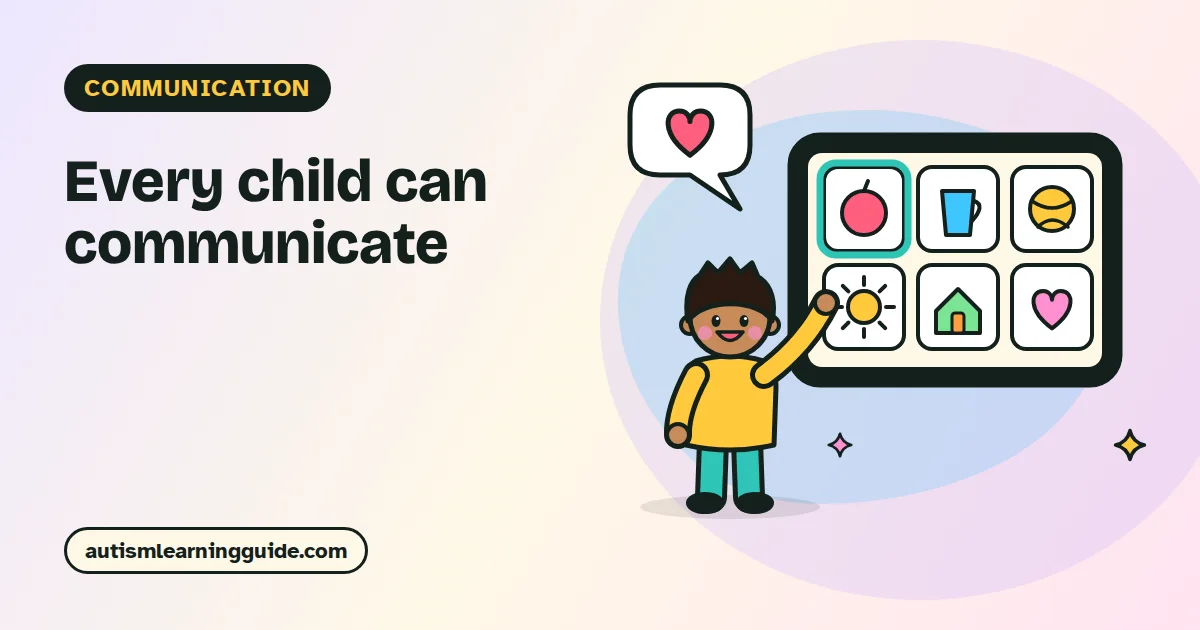
AAC for autistic children means any way of communicating other than speech, such as gestures, signs, picture cards, letter boards, or speech-generating devices and apps. AAC is a recognized evidence-based practice for autistic children. Research shows it does not stop children from learning to talk, and it can support spoken language, while giving your child a voice right now.
Key points
- AAC stands for augmentative and alternative communication. It adds to speech or replaces speech that is not yet working well.
- Research does not support the myth that AAC stops speech. Most studies show speech stays the same or improves.
- There are no prerequisites. Children do not need to “earn” AAC or reach a certain age.
- Learning AAC takes modeling: adults use the system themselves while talking to the child.
- A speech-language pathologist (SLP) can help choose and set up the right system.
On this page
What is AAC?
The American Speech-Language-Hearing Association (ASHA) explains that AAC is “augmentative” when it supplements existing speech and “alternative” when it replaces speech that is absent or not functional [1]. Many autistic children use both: some words, plus a device or pictures for times when speech is hard.
ASHA groups AAC into two kinds [1]:
- Unaided AAC uses only the body, such as gestures, facial expressions, and manual signs.
- Aided AAC uses a tool. Low-tech or “light-tech” options include picture boards and communication books. High-tech options include speech-generating devices and AAC apps on tablets.
The National Clearinghouse on Autism Evidence and Practice lists AAC as one of 28 evidence-based practices for autistic children and young people [2].
Does AAC for autistic children stop them from talking?
This is the most common worry parents have, and the research is reassuring. ASHA states that AAC does not affect motivation to use natural speech, and that combining AAC and speech therapy can help improve natural speech [1].
A research review that looked closely at the best-designed studies found that none of the 27 children and adults studied lost speech after AAC was introduced. About 89% showed gains in speech, though the gains were usually modest [3].
In a randomized trial of 61 school-aged autistic children who used very few words, children whose therapy included a speech-generating device from the start made more gains in spontaneous communication and new words than children whose therapy used spoken words alone [4]. A 2025 meta-analysis also found that adding aided AAC to play-based, naturalistic therapies was linked with larger language gains than those therapies alone for autistic children with minimal speech [5].
The main point: AAC gives your child a way to communicate now, without closing the door on speech.
Who can benefit from AAC?
ASHA says there are no prerequisites for AAC. Anyone whose communication abilities do not meet their communication needs may benefit [1]. ASHA also challenges two other common myths: that young children are not ready until school age, and that a child must first show certain thinking skills [1].
AAC can help children who:
- do not yet speak, or use only a few words,
- speak but find it hard to be understood,
- lose access to speech when stressed, tired, or overwhelmed,
- use mostly scripted or repeated phrases and need another way to say new things (see our guide to echolalia in autism).
ASHA also notes that AAC can reduce challenging behavior that comes from communication frustration [1].
Types of AAC for autistic children
Signs and gestures
Signs are always available and need no equipment. They need fine motor skills, and other people may not understand them.
Picture exchange and picture boards
Children hand over or point to pictures to make requests or comments. These are cheap, portable, and easy to start with.
Speech-generating devices and apps
A dedicated device or a tablet app speaks words aloud when your child taps a button. These can hold large vocabularies and grow with your child. A 2025 review of 20 studies with autistic preschoolers found that most interventions with speech-generating devices showed moderate to strong effects [6].
Letter boards and keyboards
Children who can spell may type or point to letters to make their own messages.
Many children use more than one type, for example signs at bath time and a tablet at school. When choosing AAC for autistic children, there is no single best system. The right choice depends on your child’s movement skills, vision, interests, and where they will use it. An SLP can help you try options and adjust them as your child grows.
How to support AAC at home
- Model, model, model. Tap or point to symbols on your child’s system while you talk, without expecting them to copy. Children learn AAC the way they learn speech: by seeing others use it.
- Keep it within reach. AAC only works if it is always available, including at meals, in the car, and at the park.
- Go beyond requests. Help your child use AAC to comment, ask questions, protest, joke, and share feelings, not just ask for snacks. A 2026 review found that most AAC research still focuses mainly on teaching requests, and called for more focus on wider communication and quality of life [7].
- Respond to every message. If your child taps “go,” treat it as real communication, even if you cannot go right now.
- Pause and wait. Give your child time to find and use a symbol.
- Keep speaking too. Talk naturally alongside the AAC. You are giving your child two ways to learn language at once.
- Share it with everyone. Teach siblings, grandparents, and teachers how to use and respect your child’s system.
Families often find the first months of AAC for autistic children the hardest, because progress can be slow and the device can feel awkward to use. That is normal. The more often your child sees AAC used in real, fun moments, the more meaningful it becomes. For more ideas, see our communication hub.
Getting AAC: assessment, school, and funding
An SLP, often with an occupational therapist, can assess your child and recommend a system. Ask whether your child can try several options before choosing.
In US public schools, the law requires the IEP team to consider whether a child needs assistive technology devices and services, and to consider the child’s communication needs [8]. Our guide to the IEP for autism explains how to ask for this. Ask your SLP about funding options in your area, as these vary by state and plan.
A warning about facilitated communication and RPM
Some methods look like AAC but are not supported by evidence. ASHA’s 2018 position statements say facilitated communication (FC) is a discredited technique that should not be used, because research shows the messages come from the facilitator, not the person with a disability [9]. ASHA also advises against the Rapid Prompting Method (RPM), citing prompt dependency and a lack of scientific validity [10]. Good AAC lets your child communicate independently, without another person guiding their hand or arm.
When to talk to a professional
Ask for an SLP assessment if your child is not using words to communicate by the age most children do, if your child’s speech is very hard to understand, or if frustration about communication is leading to distress or challenging behavior. You do not need to wait to see if speech arrives first. Starting AAC early does not mean giving up on speech.
Frequently asked questions
Will using AAC make my child lazy about talking?
No. This is a common myth. ASHA states that AAC does not reduce motivation to use natural speech, and research reviews have found that children’s speech usually stays the same or improves after AAC is introduced. Many children use speech when it is easy and AAC when it is hard, just as adults switch between talking and texting.
What age can my child start using AAC?
There is no minimum age. ASHA notes that there are no prerequisites for AAC, and that early use can support speech and language development, including vocabulary growth in children under three. Your child does not need to show particular skills first. A speech-language pathologist can suggest a system that fits your child’s age and abilities.
Is an iPad app as good as a dedicated speech device?
It can be, depending on your child. Many families use AAC apps on tablets, and research includes both tablets and dedicated devices. What matters most is a well-designed vocabulary, a sturdy setup, and lots of modeling from adults. A speech-language pathologist can help you compare options and support a funding request.
How long does it take for a child to learn AAC?
It varies. Like learning to talk, learning AAC takes time and many examples. Some children start using a few symbols within weeks, while others need months of modeling. ASHA says the time needed to learn AAC is not a reason to rule it out. Keep the system available every day and celebrate every message.
References
- American Speech-Language-Hearing Association (ASHA). Augmentative and Alternative Communication. Practice Portal. Accessed October 2026. Link
- Steinbrenner JR, Hume K, Odom SL, Morin KL, Nowell SW, Tomaszewski B, Szendrey S, McIntyre NS, Yücesoy-Özkan Ş, Savage MN. Evidence-Based Practices for Children, Youth, and Young Adults with Autism. University of North Carolina at Chapel Hill, Frank Porter Graham Child Development Institute, National Clearinghouse on Autism Evidence and Practice Review Team; 2020. Link
- Millar DC, Light JC, Schlosser RW. The impact of augmentative and alternative communication intervention on the speech production of individuals with developmental disabilities: a research review. J Speech Lang Hear Res. 2006;49(2):248-264. doi:10.1044/1092-4388(2006/021) Link
- Kasari C, Kaiser A, Goods K, Nietfeld J, Mathy P, Landa R, Murphy S, Almirall D. Communication interventions for minimally verbal children with autism: a sequential multiple assignment randomized trial. J Am Acad Child Adolesc Psychiatry. 2014;53(6):635-646. doi:10.1016/j.jaac.2014.01.019 Link
- Pope L, Light J, Laubscher E. The effect of naturalistic developmental behavioral interventions and aided AAC on the language development of children on the autism spectrum with minimal speech: a systematic review and meta-analysis. J Autism Dev Disord. 2025;55(9):3078-3099. doi:10.1007/s10803-024-06382-7 Link
- Therrien MCS, Whalon K, Nunes D, Marti P, Sellers A. A systematic review of AAC interventions using speech generating devices for autistic preschoolers. Augment Altern Commun. 2025;41(2):114-128. doi:10.1080/07434618.2025.2479768 Link
- Mifsud S, Thomas D, Bowron R, Sutherland R. The predominant focus is still on teaching children to make requests: a systematic review of AAC for autistic adults and children. Int J Lang Commun Disord. 2026;61(3):e70251. doi:10.1111/1460-6984.70251 Link
- US Department of Education. Individuals with Disabilities Education Act regulations, 34 CFR 300.324(a)(2): consideration of special factors. Link
- American Speech-Language-Hearing Association. Facilitated Communication [Position Statement]. 2018. doi:10.1044/policy.PS2018-00352 Link
- American Speech-Language-Hearing Association, Ad Hoc Committee on Facilitated Communication and the Rapid Prompting Method. Rapid Prompting Method [Position Statement]. 2018. Link
This guide is general education, not medical advice. Always talk to your child’s doctor or care team. Last checked: October 2026.