
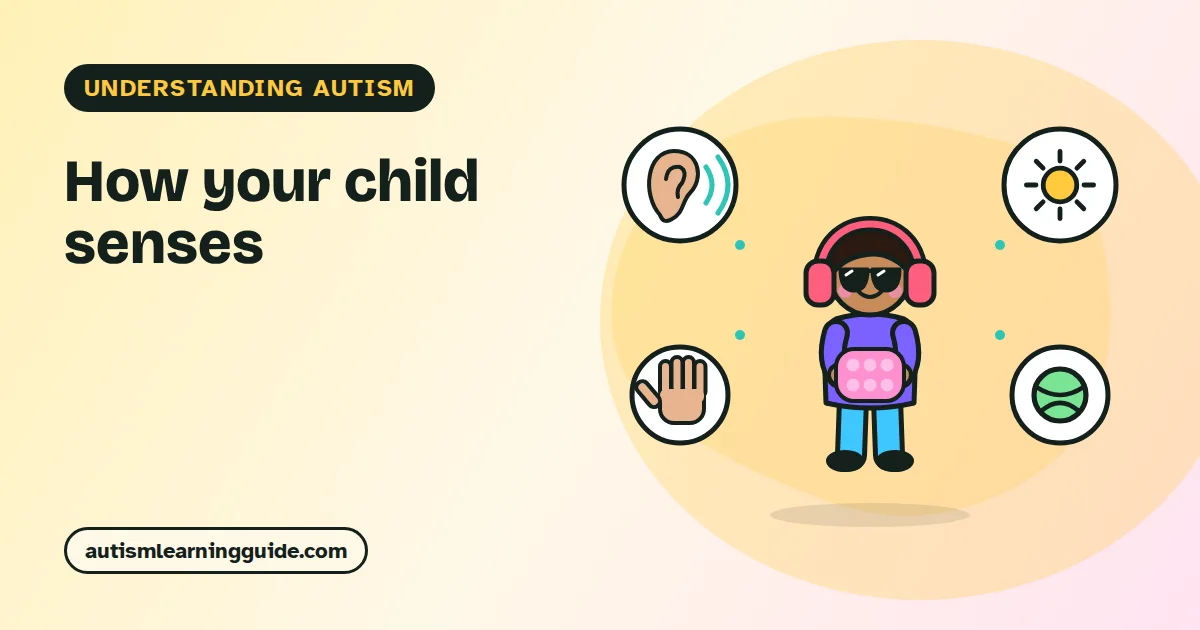
Sensory processing and autism are closely linked. Many autistic children react differently to sounds, lights, textures, smells, tastes, movement, or touch. Some are very sensitive, some notice less than others, and some actively seek out sensations. These differences are part of the diagnostic criteria for autism, and understanding them can make daily life calmer and more comfortable.
Key points
- Over- or under-reactivity to sensory input is one of the diagnostic features of autism.
- Children may be sensory avoiders, sensory seekers, under-responsive, or a mix, depending on the sense and the day.
- Sensory differences are linked with anxiety, meltdowns, sleep, and eating difficulties.
- Changing the environment and planning ahead often help more than trying to “fix” the child.
- Evidence for sensory-based therapies is mixed. Ask how goals and progress will be measured.
On this page
How sensory processing and autism are connected
The diagnostic criteria for autism include “hyper- or hyporeactivity to sensory input or unusual interests in sensory aspects of the environment” [1]. Examples include apparent indifference to pain or temperature, a strong dislike of certain sounds or textures, excessive smelling or touching of objects, and fascination with lights or movement [1].
A meta-analysis of 14 studies found that sensory symptoms were much more common in autistic people than in typically developing peers. The biggest difference was in under-responsiveness, followed by over-responsiveness and sensation seeking [2]. The American Academy of Pediatrics (AAP) notes that sensory symptoms may be more noticeable in younger children [1].
The US special education law, IDEA, also lists “unusual responses to sensory experiences” among characteristics often associated with autism [3].
Types of sensory differences
Over-responsive (sensory avoiding)
Your child may find everyday sensations overwhelming or painful. Signs include covering ears at hand dryers or vacuum cleaners, refusing certain clothes or labels, gagging at food textures, avoiding messy play, or getting upset in bright or crowded places.
Under-responsive
Your child may not notice sensations others do. They might not react to their name, seem unbothered by cuts or bumps, not notice being cold, or not seem to feel hunger or a full bladder.
Sensory seeking
Your child may crave certain sensations: spinning, jumping, crashing into cushions, chewing on objects, touching textures, or watching spinning things or lights.
Most children have a mix. A child might be over-sensitive to sound but seek deep pressure and movement. Sensory needs can also change with tiredness, stress, illness, or age.
The “hidden” senses
Beyond the five familiar senses, sensory processing includes balance and movement (vestibular), body position (proprioception), and internal body signals such as hunger, thirst, pain, and needing the toilet (interoception). Differences here can affect coordination, toileting, and eating.
Why sensory processing and autism matter in daily life
A 2024 meta-analysis of 63 studies with more than 11,000 autistic participants found that sensory processing differences were linked with both internalizing problems, such as anxiety, and externalizing problems, such as challenging behavior [4]. Over-sensitivity, especially to sights, sounds, and touch, had some of the strongest links [4].
In one study, most autistic adults described feeling overwhelmed by their senses, by information, and by social and emotional stress during meltdowns [5]. Sensory processing and autism also overlap with feeding and sleep challenges, such as refusing food textures or being woken by small noises. You can read more in our guide to autism meltdowns vs tantrums.
Is sensory processing disorder the same thing?
You may hear the term “sensory processing disorder” (SPD). The AAP notes that SPD is not a separate diagnosis in the DSM-5, the manual used to diagnose autism [1]. A 2012 AAP policy statement advised that, because there is no universally accepted framework for diagnosis, SPD generally should not be diagnosed, and that difficulty processing sensory information can be part of many conditions, including autism, ADHD, developmental coordination disorder, and anxiety [6].
So if your child has strong sensory differences, it is worth having a full developmental evaluation rather than looking only at sensory issues. See our diagnosis and assessment hub.
What you can do at home
When it comes to sensory processing and autism, often the most helpful step is to adapt the environment, rather than expecting your child to tolerate discomfort. UK NICE guidance recommends considering individual sensory sensitivities to lighting, noise levels, and even the color of walls and furnishings when adapting settings for autistic children [7].
- Become a sensory detective. For a week or two, note what your child avoids, seeks, and finds calming, and what happens before hard moments.
- Reduce overload. Offer noise-reducing headphones, sunglasses or a cap, dimmer lights, or a quiet corner.
- Choose comfortable clothes. Tagless, soft, seamless clothes and familiar items can prevent daily battles.
- Plan outings. Visit stores or parks at quiet times, and bring a “sensory kit” with headphones, a favorite fidget, and a snack.
- Offer healthy ways to seek input. Trampolines, swings, climbing, heavy work such as carrying groceries, chewy snacks, or safe chew tools can meet seeking needs.
- Build calming breaks into the day. Short, regular breaks can prevent overload from building up.
- Warn about sensory events. Tell your child before the vacuum, a fire drill, or a haircut, and use visuals to show what will happen. Our visual tools page can help.
- Respect “no.” If a sensation is truly distressing, forcing it usually makes things worse. Gradual, choice-based exposure works better.
Many of these ideas can also be written into school plans as accommodations.
Sensory-based therapies: what the evidence says
Occupational therapists (OTs) often support children with sensory differences. Approaches include Ayres Sensory Integration (ASI), which uses play-based activities with swings, textures, and movement, and “sensory diets,” which are planned sensory activities through the day.
The evidence is mixed and still debated:
- A 2017 systematic review found that sensory integration-based approaches improved some sensory and motor measures in the short term, but the strength of evidence was low [8].
- The 2020 National Clearinghouse on Autism Evidence and Practice report lists ASI as an evidence-based practice, based on a small number of studies. It lists sensory diets as having only some evidence, not enough to be called evidence-based [9].
- A 2025 review of nine randomized trials found that ASI delivered with fidelity helped autistic children meet individual goals, but did not help with behaviors such as irritability or resistance to change [10].
- A 2026 review was more cautious. It found limited evidence for ASI and recommended using better-supported strategies for families’ priority goals and modifying environments for children with sensory difficulties [11].
The 2012 AAP statement suggested that occupational therapy using sensory-based approaches may be one part of a broader treatment plan, and encouraged families to agree on a trial period and clear ways to judge whether it is helping [6]. The American Occupational Therapy Association’s 2024 practice guidelines for autistic people emphasize goal-oriented, multidisciplinary support focused on participation in meaningful daily activities [12].
A practical approach: if your child starts a sensory-based therapy, agree on specific goals, such as getting dressed with less distress or tolerating a haircut, and review progress after a set time. Learn more in our guide to occupational therapy for autism.
When to talk to a professional
Talk to your child’s doctor or ask for an occupational therapy assessment if:
- sensory reactions are stopping your child from eating a varied diet, sleeping, dressing, bathing, or going to school,
- your child often hurts themselves or seems not to notice injuries,
- sensory overload is leading to frequent meltdowns,
- your child is very restricted in where they can go or what they can do.
If your child does not seem to notice pain or temperature, make sure their doctor knows, so injuries and illness are not missed.
Frequently asked questions
Do all autistic children have sensory issues?
Not all, but many do. Sensory differences are common enough that they are part of the diagnostic criteria for autism, although a child does not need them to be diagnosed. Research shows sensory symptoms are much more frequent in autistic people than in their peers, and they vary widely: some children are very sensitive, others under-responsive, and many seek certain sensations.
Can sensory issues be cured?
Sensory differences are part of how many autistic people experience the world, so the aim is comfort and participation rather than a cure. Some children become more able to tolerate certain sensations as they grow, especially with support and gradual, choice-based exposure. Adapting the environment, such as using headphones or softer clothing, often makes the biggest everyday difference.
Does sensory integration therapy work for autism?
The evidence is mixed. Some recent reviews found Ayres Sensory Integration helped autistic children meet individual goals, while others found limited evidence, and it did not appear to help irritability or resistance to change. If your child tries it, agree on clear goals with the therapist and review progress after a set period to see whether it is helping.
Is it OK to let my child stim for sensory input?
Generally, yes. Many autistic children move, rock, flap, or seek textures and sounds to get sensory input or to calm down. If stimming is safe and not causing harm, there is usually no need to stop it. If a behavior is causing injury, talk to your child’s doctor or occupational therapist about safer ways to meet the same sensory need.
References
- Hyman SL, Levy SE, Myers SM; Council on Children With Disabilities, Section on Developmental and Behavioral Pediatrics. Identification, evaluation, and management of children with autism spectrum disorder. Pediatrics. 2020;145(1):e20193447. doi:10.1542/peds.2019-3447 Link
- Ben-Sasson A, Hen L, Fluss R, Cermak SA, Engel-Yeger B, Gal E. A meta-analysis of sensory modulation symptoms in individuals with autism spectrum disorders. J Autism Dev Disord. 2009;39(1):1-11. doi:10.1007/s10803-008-0593-3 Link
- 34 CFR 300.8: Child with a disability (definition of autism, 300.8(c)(1)). Code of Federal Regulations. Legal Information Institute, Cornell Law School. Link
- Chen Y, Xi Z, Saunders R, Simmons D, Totsika V, Mandy W. A systematic review and meta-analysis of the relationship between sensory processing differences and internalising/externalising problems in autism. Clin Psychol Rev. 2024;114:102516. doi:10.1016/j.cpr.2024.102516 Link
- Lewis LF, Stevens K. The lived experience of meltdowns for autistic adults. Autism. 2023;27(6):1817-1825. doi:10.1177/13623613221145783 Link
- Zimmer M, Desch L; Section on Complementary and Integrative Medicine; Council on Children with Disabilities; American Academy of Pediatrics. Sensory integration therapies for children with developmental and behavioral disorders. Pediatrics. 2012;129(6):1186-1189. doi:10.1542/peds.2012-0876 Link
- National Institute for Health and Care Excellence (NICE). Autism spectrum disorder in under 19s: support and management. Clinical guideline CG170. Published 2013; last updated June 2021. Link
- Weitlauf AS, Sathe N, McPheeters ML, Warren ZE. Interventions targeting sensory challenges in autism spectrum disorder: a systematic review. Pediatrics. 2017;139(6):e20170347. doi:10.1542/peds.2017-0347 Link
- Steinbrenner JR, Hume K, Odom SL, Morin KL, Nowell SW, Tomaszewski B, Szendrey S, McIntyre NS, Yücesoy-Özkan Ş, Savage MN. Evidence-Based Practices for Children, Youth, and Young Adults with Autism. University of North Carolina at Chapel Hill, Frank Porter Graham Child Development Institute, National Clearinghouse on Autism Evidence and Practice Review Team; 2020. Link
- Acuña C, Gallegos-Berrios S, Barfoot J, Meredith P, Hill J. Ayres Sensory Integration with children ages 0 to 12: a systematic review of randomized controlled trials. Am J Occup Ther. 2025;79(3):7903205180. doi:10.5014/ajot.2025.051023 Link
- Kishida Y, Stephenson J, Kemp C, Salisbury C. Efficacy of interventions adhering to the revised Ayres Sensory Integration fidelity measure: a systematic review. J Autism Dev Disord. Published online 2026. doi:10.1007/s10803-026-07283-7 Link
- Patten KK, Murthi K, Onwumere DD, Skaletski EC, Little LM, Tomchek SD. Occupational therapy practice guidelines for autistic people across the lifespan. Am J Occup Ther. 2024;78(3):7803397010. doi:10.5014/ajot.2024.078301 Link
Professional review: this guide is waiting for review by a qualified clinician. It was written and checked against the published sources listed above. How we check our guides.
This guide is general education, not medical advice. Always talk to your child’s doctor or care team. Last checked: October 2026.